Thursday, May 30, 2019

Amarillo Reflections

"Don't be afraid of being the 'poor' school, be the 'problem-solving' school." That simple but powerful takeaway was part of my learning last Monday and Tuesday as I attended the Amarillo College Culture of Caring Poverty Summit. I was lucky enough to join a team of three from my college, and the summit did not disappoint. We met a humble, inspiring, hard-working group of people who are open to sharing their mission and their successes and flaws in the name of ending poverty and changing the world. We learned about the theory of change which drives their planning on campus. It is pictured above and is so simple and elegant, it almost hides the effort required to execute such ambition. As I said to my colleagues several times during our visit, this isn't complicated, it's just hard. Anyone who has been reading these articles (and thank you for that) knows we have been deeply inspired by the work at Amarillo College, so being there was invaluable. At this point in my career, I can be pretty crusty about conferences, but this one was everything I hoped for. Let me share a few things I learned in hopes you will be inspired to move down this path as well. But first, I'll share some local news video featuring Amarillo College's dynamic leader, Dr. Russell Lowery-Hart.


At Western we talk about increasing the sense of belonging and self-efficacy for students as part of poverty-informed practice. Making those things concrete enough for others to implement can be a challenge, so I love it when someone else says it better than I do. Early on day 1, someone asked Dr. Lowery-Hart about potential abuse of the support they provide for students and he responded simply, "If you need it, we are going to believe you." Bingo! That is creating belonging in a nutshell. Our assumption is that students in the crisis of poverty are already apprehensive about being on campus and the odds of someone providing help and judgment at the same time in their prior life is pretty high. We must choose to simply believe them. It isn't easy to seek help, particularly when people not in poverty have invisible help built into their everyday lives. The least we can do is simply believe the person who has the courage to be vulnerable and ask. I texted the quote to my partner Mandy and she immediately replied believing in students is the number one place we fall down... We can start fixing that on Monday. We need to normalize help because everyone needs it whether they see it or not. And embedded, easily accessible help creates belonging. Let's help with no questions asked (except what else do you need) if possible.


Dr. Donna Beegle (who I actually got to talk with in Amarillo) reminds us perceptions of scarcity often drive our policy and practices when in reality there is enough for all, it's just a matter of choices. Amarillo's Advocacy and Resource Center (ARC) is evidence of that truth. What's pictured is a small part of their "overflow" storage which they use to stock the five (yes 5) food pantries they run across their campuses. This picture reminded me there is enough and it also reminded me there is tremendous need. The amount of food and supplies the pantry goes through is amazing. It is also amazing the staff of the ARC have built such excellent community connections that all of this comes from donors... Amarillo has invested in staff to build relationships and those relationships have paid off exponentially in support for students, increased retention, and graduation. This in turn breaks the cycle of poverty and changes lives for individuals, families, and communities. As I keep saying, it is not complicated, it is just hard, and it is a choice. The ARC is led by a remarkable woman named Jordan Herrera (pictured telling the ARC story) and a team of social workers. The value of social workers is another lesson we are bringing home. You don't have to be one, but you better know one, or better yet employ a few. I will admit to being happy when visiting the ARC and seeing their "grab and go" table, which is modeled on The Bowl at Western (The Bowl) and I was doubly pleased when Jordan and her staff said the no barriers snack table gets filled frequently and the amount of food students take rivals the pantry... If they need it, they believe them, and so do we. We will challenge ourselves to prove resources are scarce instead of starting with that as untested assumption. There is enough, we just need to choose what we do with it.

Part of my own personal evolution has been to move from thought and planning to a bias for action. As someone who really likes context and history, I can get stuck in a loop of looking at options and possible drawbacks to the point of not acting. Dr. Lowery-Hart described a similar shift when he said Amarillo strives to be data-informed, but not necessarily data-driven. I was pleased to talk to him about this idea over lunch because "data-driven" is a pretty ubiquitous term across higher education. He assured me I heard him correctly, and he also explained why he chose that term. He said his observation is too frequently people are searching for the piece of data that will absolve them of ownership of a decision. His vision of leadership is to get data that helps and then move on it realizing he may get it wrong and remaining accountable for doing so. This vision of leadership struck a chord with me as I have suffered from occasional paralysis by analysis and perhaps failed to act. I think being data informed means you are iterative and brave. I think it means being brave enough to own your theory of change and pursue it relentlessly and fearlessly. I was struck by the common use of language and imagery among the staff at Amarillo College, and one of the phrases they used was not to "higher ed" things too much. My reading of that phrase is we need to resist our urge to make the routine look impossible, and we need to be ok with uncomplicated solutions that are simply hard work. I'm not sure I'm as fearless as Russell, and I know I'm not as fearless as his VP Cara Crowley, but I'm inspired to move my team in their direction. This stuff is urgent, we must act.

I didn't expect to cry at this gathering, but I did. It happened when a student named Steven stood up and told us his experience at Amarillo College and said this: "I used to see people that looked happy, with jobs they liked, and nice cars, and I thought, that's nice, but that's not for me..." It wasn't a plant; he was giving an impromptu talk at a session about building the ARC and was sharing about the help he received in the most genuine way. Steven was amazing and such a good example of the amazing work happening in Amarillo. I left the conference with a renewed sense of mission and purpose. I am certain this is the right work, and it has been the right time for this work for longer than I care to admit. The Stevens of the world have a right to see their possibilities just like my children do. It's been almost a week, and I still get tearful picturing him saying "that's not for me." That is messed up, and we have the opportunity to be a solution. The things we will learn serving our students with the largest barriers will teach us how to be great colleges for all of our students. On my last day in Amarillo, I got word we will devote our fall professional development days to poverty-informed practice, and I will have an opportunity to deliver the keynote address at our college day!! If I learned anything last week, I learned about the power of passion and purpose, and I will bring every ounce I have to our campus. Game on!

Sunday, May 26, 2019

Amarillo by Morning

Four years ago I fulfilled a promise to my then 10 year-old son. He read a book a couple years earlier about Route 66 and wanted to do a road trip. I said something like "maybe when you're 10..." He forgets some things, but he did not forget that. That's him in the picture on the day we left for our 8 day road trip to the Grand Canyon via Route 66. It was an amazing week. In preparation, we made a road trip music list, trying to associate songs with landmarks. We enjoyed living on 'Tulsa Time' and we stood on THE corner in Winslow, Arizona. And of course we made it to 'Amarillo by Morning'. I remember Amarillo well actually because western Oklahoma and the Texas Panhandle seemed to consist of mostly wide open space, so we were grateful to hit a city and take a break from our travels. We got lunch, checked out the local zoo, and visited the Cadillac Ranch. After that we set back out on our road trip, and I assumed I'd never see Amarillo again... Fate is funny. I'm excitedly heading back to Amarillo next week for the Amarillo College Culture of Caring Poverty Summit. I've been working a long time, and I've been to a lot of conferences, so to be this excited to travel on a Sunday is not normal. But this opportunity is not normal. It is a chance to be together with a group of people who think like I do, that poverty is the single greatest obstacle to student success. It is a chance to bring a team from my college to learn and return to our college to expand this work I believe in so much. Attacking poverty barriers is so important, and I remain committed to it at my core. Let me help you understand why.

I'm excited to go to Amarillo on behalf of my friend Emmie (Emmie's story). Emmie is currently not in school, but I saw her the other day, and she is working on a return plan. She is working at a local restaurant and gathering herself for pursuit of her dream. We have to build structures to help Emmie pursue her dream of owning a bakery. We can't require heroism, we just need to create a system that allows her non-linear journey to end in success. Emmie continues to overcome barriers that would floor most of us, and I want us to be the college that includes her and learns from her. She is counting on us to be the place that helps her have the life she dreams of. I think we have to be worthy of her trust.

I'm going to Amarillo on behalf of my friend John (John's story). John used his HSED and college credit to start our precision machining program. John, and the team of people who care about him, made a choice to shift to welding in the spring, and he continues to work hard at it. Math doesn't come easy for John, but he is here in our department for the summer term, brushing up his math skills to pass Math for Welding. The welding certificate he will acquire when he is done will give him access to better jobs, better wages, and a better future. I'm going to Amarillo because the world needs people like John to have opportunity. One of our premises of poverty informed practice is that our students with barriers teach us more than other students ever could. John is always so positive and grateful, but in reality we should be just as grateful to him. John doesn't know it, but he's showing us how to get better every day.

I'm going to Amarillo on behalf of my friend Andrea (Andrea's story). That's Andrea on the left, alongside her friend and my associate dean, Mandy. Andrea's story continues to grow. Not only did she use her HSED and college credits to start pursuing an Associate's Degree in Human Services, she's actually working for me (hence the desk and computer) currently as part of our office team. When we had the opening, I remembered a story I heard Dr. Donna Beegle tell about her friend Shariff telling her it was nice her car had a house (aka garage), when so many people didn't. She put the car on the street and made temporary housing in her garage. If she could do that, the least I could do is provide a student with an opportunity to work and build stability. I'm a bit repetitive, but Andrea has taught us so much already, we would be foolish not to have her as part of our college and team.

So I'm going to Amarillo on behalf of some heroes of mine and to meet some other heroes of mine. But I'm also going to Amarillo for the kid in the ancient graduation picture. As oddly gleeful as he looks surrounded by his grandparents with his 80's quasi-mullet, that was actually one of the toughest days of his life. Just a few short hours before the ceremony and this picture, the police were at his house to deal with a stepfather who had too much to drink and was violent to his mother. He glued a smile on his face and played a part, and he kept the secret of what happened in his house, even though it happened pretty regularly. I often think about that day (more so lately because my daughter is graduating in a week), because it reminds me there is always more to the story. No one at my school ever asked me about my life at home. I just smiled and got good grades and built up my defenses. Now I know, we must love our students and we must assume our help is not optional. Now I know, we must strive to get past the surface and find the barriers that are preventing them from having the lives they dream of. I can't wait to get to Amarillo (by morning or midnight as the case may be), and see what we can become.

Tuesday, May 14, 2019

Filters vs Pumps

The power of language has always been a true love of mine. It is probably a bit of rationalization on my part since I'm not a very visual person, but I've always loved when I (or someone else) says
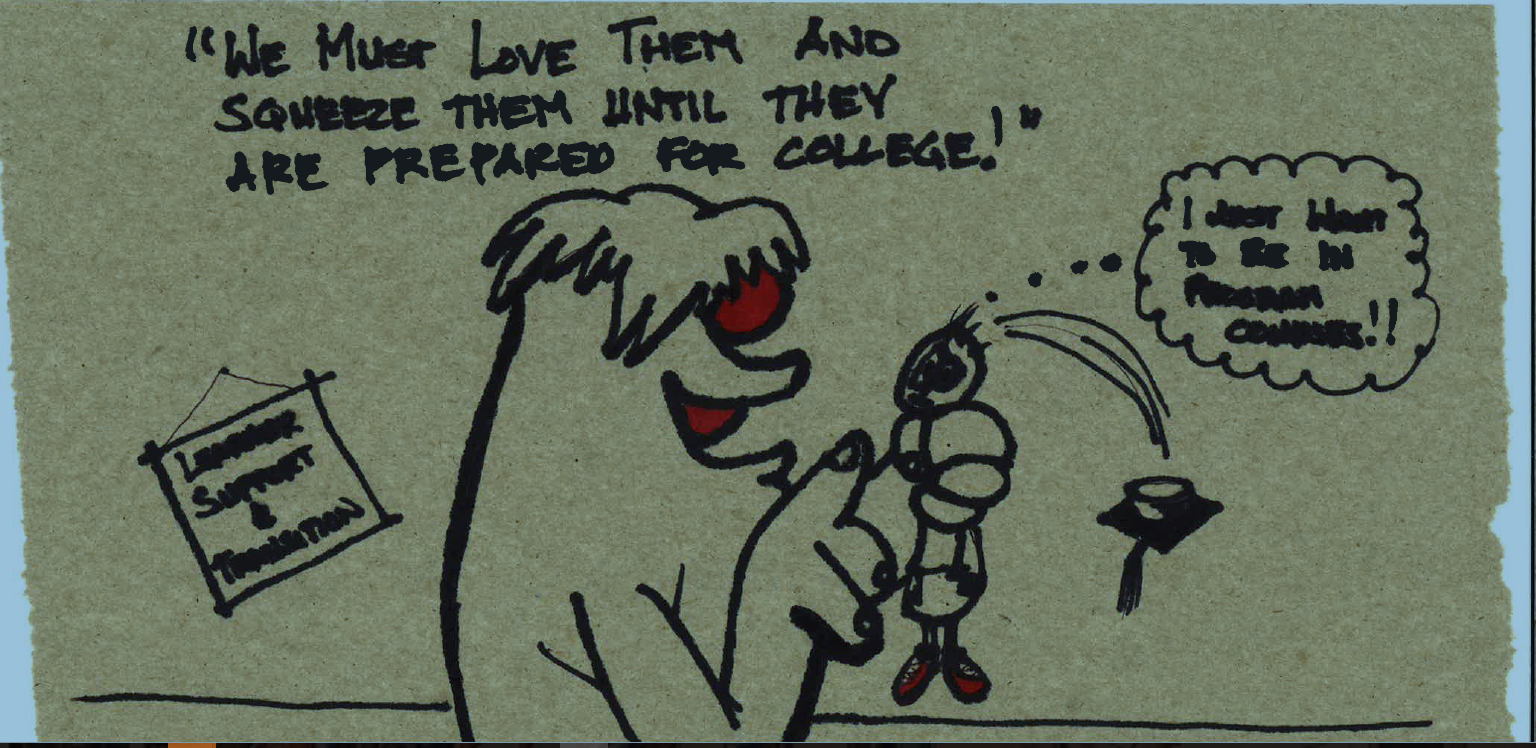
something that simply and succinctly makes a point in a way that anyone could grasp. It's even better if the point is so good, no one can disagree, but that can be too much to ask. Strengths and weaknesses always seem to be two sides of the same coin and my verbal strengths have always been balanced by an inability to represent my ideas in pictures, charts, sculpture, painting, or any other visual medium. As I've gotten older, I've become more comfortable with my weaknesses and find myself drawn to people with the gift of capturing ideas visually. One of those people is my friend Mike (pictured). Mike has a gift for capturing my sometimes random ideas visually, often on a piece of paper towel:) A couple of years ago, I was trying to capture our switch from an old model of developmental education, where we "fixed" people and basically never let them go, to a "just-in-time" model that helps people where they
actually are and need to be. I was drawing stick people on a board and Mike just watched. Later that afternoon, he handed me a paper towel with this character drawn on it. Our old model was the Abominable Snowman and our students were Daffy Duck just yearning to be free. One picture said it all brilliantly. I've included the picture above, but this video also gives you the idea.


A few days ago I was trying to tell Mike about a shift I think a poverty-informed college must make. I was working on some tortured analogy about Harry Potter and the Sorting Hat (I called it tortured here too), but it wasn't capturing the idea I hoped for. I wanted to show we weren't here to eliminate the unworthy, but rather to create opportunity for the widest group possible. This hit a chord with Mike and he described a conversation he had been in where someone had said, "we are a filter, not a pump" in an attempt to justify "weeding out" as a college practice. Mike and I agreed if filtering had ever been a good idea, it certainly wasn't now, and I left to go back to my day. The analogy stuck with me and the next day, I thought I would be funny and tell him I had extended the analogy to me being a plumber breaking up clogs. I even joked I was going to come to meetings with a plunger from
now on to unclog the system for students. Later that day, this picture showed up in my email. On one paper towel, Mike had captured exactly what poverty-informed practice should be doing. My admiration for visual people grows.

 
This filter versus a pump mentality is worth calling out. As we move toward the most inclusive poverty-informed environment possible, we need to identify our filters and see if we can remove them. One of the toughest changes my college has made in the last two years was a de-emphasis on placement testing. As I've noted before, if you try to change an entrenched system, the resistance will be huge, and this was true with our assessment and placement work. It was common knowledge we weren't doing placement very effectively, and that was mirrored across the nation at colleges like ours. However, there was a deep level of attachment to the testing system we had. The reaction to the changes seemed almost personal, and that always confused me because the people involved were generally reasonable and would consider themselves advocates for students. I think the real subtext of the discussion was the change from a filter mentality to a pump mentality. We had used placement tests to filter students or protect them from themselves. The latter seems almost noble until you really start to unbundle it. One of our premises in our poverty-informed work is what students know on day one is not a very good indication of what they can learn. So, instead of filtering them out at the beginning (which was reality because the transition from remedial coursework wasn't very good), we were shifting to a mindset of building structures that helped our students successfully move through... you know, like a pump. Protecting students from themselves seems paternalistic to me. Eliminating unnecessary barriers and walking beside them seems like a partnership.

The pump is a great analogy because it isn't one size fits all. One of the persistent questions I get about the students I advocate for is, "shouldn't we treat them the way we treat the rest of the students?" This is a loaded question because the assumptions behind it are everything. If people meant we try to give all students what they need, then this makes perfect sense. Unfortunately, most times the question seems to imply we should just give everyone the same thing. This thinking is flawed on two levels. First, there is a difference between equitable and equal, a huge difference. Most people understand this. I think the more insidious flaw in asking people with significant barriers to access the system other students do, in the same way, is the system was not designed for them. Does that make sense? Because I think it's a big deal. College systems are built on assumptions of who they will serve. It seems natural those assumptions would not be about students with the greatest barriers. So, until the day we start building our systems that way, let's build effective pumps to help them navigate plumbing that wasn't always designed with them in mind. This is different than building separate systems. It is adding appropriate support at points in the system where students have historically struggled. Essentially we are installing a pump with the appropriate pressure to move them past a potential clog. These are poverty-informed supports, and if we built our systems with students from poverty first in mind, they might not be necessary, but I don't think that is likely or practical. So, we build in supports to navigate an inherently flawed system and use what we learn to improve it. That is poverty-informed in my opinion.

Filters, pumps, and plumbers seem like a great way to represent a technical college learning to serve its students in new and more effective ways. Perhaps there was a time where deciding who should be in college and who shouldn't was ok, although I doubt it since it was instructive to see who was excluded. But even if that time existed, it has passed. My father told me when his high school class graduated in the late 1960's, a number of his classmates moved to southern Wisconsin and took jobs at an automotive plant. Those were the kind of jobs a high school graduate could build a life on, a life that provided for a family. That layer of employment has essentially left our economy, and we have told young people post-secondary credentials are the key to success in the new economy. I believe that to be true, so I also believe filtering students out is a process of picking economic winners and losers, and we do not belong in that business. In a "post-secondary education for all" world, it is incumbent on colleges to adapt to the new world as well. We need to get out our wrenches, and yes our plungers, unclog the filters, and install pumps wherever we need to. It took me five paragraphs and Mike got it in one drawing...

Thursday, May 2, 2019

A Tale of Two Weeks

With apologies to Charles Dickens, in some ways the last week felt like the best of weeks and the worst of weeks all at once. The week started with frustrating meetings that felt like they were impeding what we are trying to do. What seemed like straightforward simple steps to helping people and normalizing help were getting caught up in the web of bureaucracy. I was convinced if you try to disrupt a system, the system fights back, and the system probably wins. I believe I even vented that frustration on Twitter. What's hard to understand about opposition is it comes in the most insidious ways, often from the nicest, well-meaning people. My industry tends to be a little risk averse, so if you are "out there" on an idea, people will search for precedent to justify it, and if they can't find it, the pace of change can slow to a crawl. I've been the risk-averse person in the past, so I don't get upset with anyone personally, but I do have new empathy for people I've held back. It is very hard to see a problem so clearly and have to navigate others' hurdles to solve it. Social media has turned out to be a great place to find inspiration to continue in those low moments, and my friend Cara Crowley picked me up in the most succinct way. She seems to be sort of gifted that way and reminded me "We are their (students) advocates & they are our inspiration. The rest is silliness & frustrating nonsense." Just what I needed and so perfectly said...


Navigating systems is challenging, but it was also the best of weeks. I had a chance to present on our work at the local library to an audience of library staff and parent-educators. The parent-educators emailed me to say they are meeting this week to discuss how to implement some poverty informed concepts in their world, and I can't wait to hear back where our ideas took them. Our library was already doing cool stuff like the video above, but they were enthused to find like-minded folks, and I hope we can reduce barriers together going forward. Public libraries are pretty poverty-informed by definition, and ours serves as a de facto daytime homeless shelter, so I am excited to learn from them. I also got to co-present on campus with my colleague Kirsten Daykin (pictured here) who is doing amazing work about trauma and education. Our feedback was quite positive as well, but the week was topped off by organizational good news. Our Vice President (my boss) shared my division would be taking on new responsibilities in our Learning Commons, which I'd been advocating for and was thrilled to learn, but more remarkably her college wide email said this: "(Our Division's) passion and progressive work with poverty informed practices will help guide just-in-time supports and reduce barriers to student success." It was the best week indeed!


Our college strategic plan is very focused on equity and inclusion, but if I'm honest, I'm not sure the word poverty appears in it. In less than a year, our steadfast, unapologetic commitment to students in poverty and their potential has made reducing poverty barriers a linchpin of our equity efforts. So, even the parts of the week where it felt like an uphill climb are easier to take when I see that in action. It's funny what an email can do. Use of that simple term was affirmation our movement is taking hold and now we have a few more levers to push to make it happen. If there are lessons to be learned from our efforts, I think it might be as simple as a bias for action. Start doing things. Be brave and unapologetic. Maybe it was the safety of the library space and so many like-minded people, but I closed on Wednesday by telling that group we do not have to apologize for helping people get what they need and deserve. I often think of Dr. Donna Beegle's challenge to think about what someone must do to be worthy of your help. It's such a good way to find your own bias and root it out. So often, I hear well-meaning people basically require a ridiculous amount of gratitude for simply getting what most folks get. I wonder why that is? Who is that for? Doing what we are doing isn't charity, it's smart business with the benefit of being just. Let's stop apologizing for doing things that are correct and smart.

My speaking (for free:)) calendar is starting to get fuller. I love the chance to talk about what we are doing in part because I think it's important, but also because it helps us hone our message. We have tried to simplify and have really boiled down to two big concepts. The first concept is about a mindset shift that puts us in awe of our students who live in poverty and choose us anyway. This frame stops us from feeling sorry for people and activates our need to assist them in this audaciously courageous pursuit. The second concept is a commitment to reducing barriers at every opportunity. Barriers can be large or small, but any barrier can be a deal-breaker when even basic needs are tenuous. We also believe this work requires an intentional choice to love the students we have. We put love in the action category because we want it to be something we choose intentionally. You do things differently for people you love. It's just different than "caring about" and certainly far different than "feeling sorry for." In my most recent presentations at our college, I said our work boils down to helping change economic reality for people we love. It's hard to have a bad day at work if you frame it like that.


In one week, it was the worst of times and the best of times. It was the age of foolishness and the age of wisdom. Before my graduate school instincts kick in, and I start creating APA citations, let me close. If you choose to advocate for those who have been traditionally left out, you can expect to hit a point where you are no longer cute or admirable and are actually a threat to entrenched systems. That is the point where you will make a decision. You will either retreat back to pilot projects and small impact, or you will be brave and persevere. As someone who has been on both sides of that equation, let me reassure you that you will feel safer and more comfortable if you retreat. But, if you are like me, this safety and comfort will eventually feel unearned. It will feel like undeserved privilege, and the safety and comfort of your own life won't bring you the relief you seek. You will begin to wonder if it is ok to be this comfortable when others do not get a comparable choice. You will remember the seemingly random turns in the road which put you in your situation and not theirs. And if you persevere, you will remember poverty is a circumstance, not a character flaw, and get back to work helping people you love change their economic reality.

Friday, April 26, 2019

Giving Voice

Saturday was a big day, it was graduation day! For those of us in education, graduation is the
confirmation of our reason for doing what we do. After all these years, I've been to a ton of them, but they are all special and re-energize me on some level. The picture is my friend Dio in his cap and gown, and that's the president of our college photo bombing in the back:). Dio is a pretty remarkable person, and I've been glad to get to know him a little bit over the last few years. He's a huge basketball fan and knows the game, so we connect on that front. So, I was a little taken aback earlier in the week when Dio challenged me with a semi-playful taunt of I "told everybody's story but (his)." I immediately said we will capture some time on video soon (stay tuned), but it made me think about what he really meant. Part of our movement towards the most poverty-informed approach possible is to give voice to people who have been left out, and Dio was reminding me his voice should be heard too. It made me wonder where else we might miss important voices in our poverty-informed conversation.

Last fall I attended the #RealCollege convening in Philadelphia (read more here), and one of the rules espoused there was "No conferences about students, without students present." They backed up their rhetoric with funding to support student attendance and with student-led panels. It's the best conference I've been to in years, and the feel from the strong student element was a primary reason. I thought back to efforts I've been involved with on our campus to include students, and how we struggle to do it well. I spent many years on a Diversity Advisory Team at my college, and while we always attempted to include students, they invariably faded away. The most consistent participant was a returning adult student who was an officer in our student government, but even she eventually told me that students felt like they were watching a meeting not participating in it. I never solved that issue, and when I look back, it's uncomfortable to think about. We would often turn to the student representative (it was rarely more than one) and ask them "what do students think about (blank)?" As I've grown my knowledge in equity and inclusion, it was a stunningly patronizing and privileged question. No one ever asked me to represent all the middle aged, middle managers with gray hair, but we did it to them all the time. So, it has me thinking about how we honor people who deserve a voice, but rarely get one. If we aren't sure how to effectively include our students in general, what are we doing for those with the most barriers and who may have been disregarded for much of their life?

My mind keeps coming back to the inherent power differential in the staff/faculty to student dynamic. Perhaps beginning to dismantle as much of that as possible is a place to start. In an age where every fact in the world is 5 seconds away on a smartphone, the act of "teaching" has changed anyway. Simply distributing the information I hold to someone who hasn't seen it yet was probably never good teaching, but now it's not even practical. Information is cheap, but relationships are gold. Building relationships of mutual respect seems to be a very poverty-informed way of seeing the world, but what does that look like? I don't have all the answers, but for us, it starts at the point of first contact. If you want to pursue Adult Education in my division, the first "instructors" you will have are the Dean and Associate Dean in the orientation we call "Introduction to Adult Learning (IAL). It's selfish on some level because I want to get to know students, but it also reduces barriers between us, because we use first names, and we have real discussions. We work to become something other than our titles because IAL is a relatively casual experience, and the emphasis is on the student and their plans. It is important to us students know immediately we have no interest in gate-keeping or evaluating their worthiness, rather we are there to become partners in their dreams.

All too often in education, I hear stories that make me think of a kind of tortured Harry Potter Analogy. I hear too many conversations where we seem to be functioning as sorting hats rather than advocates for success. If you didn't read Harry Potter, the Sorting Hat is placed on students' heads and assigns them to their house at Hogwarts School. The houses all seem to have a prototypical profile and type (find your house here), and the house they are sorted into has a lot to do with their character arc. Our education version comes out in insidious phrases like "s/he wouldn't make it at the university" or in behavior that tells students they don't belong because they don't use words the right way or some other hidden rule. Did students have input in how their class runs or was it all preordained? Students in poverty might not meet our norms on day 1, but that does not indicate what they are capable of learning. It is all too easy to slide into a place of judgment and decide what people are capable of without ever adding their voice to the conversation. Dismantling the power differential starts to change the conversation to "what does this person need to succeed" instead of "they don't have what it takes to succeed". How many times are we making sorting hat judgments and leaving potential untapped? After nearly 20 years looking at higher education from the inside out, I know we have not figured out this thing called "college" so well that we know who it is for and who it is not for. In addition, things change so rapidly, including an economy which basically requires post-secondary training, that the old rules don't apply, if they ever did. I would also argue a poverty-informed approach empowers the college to pursue solutions rather than selecting winners and losers in the new age.

I don't want to imply we have this stuff figured out, because we don't. I just suspect our journey to
being poverty-informed in our offices and classrooms is going to require us to give greater voice to those we serve. Just this winter, we were pleased to include a student on a big college trip, and none of us anticipated her panic when we sent her an expense report to get reimbursed for the trip. How do you reimburse someone who has nothing? How many other assumptions did we make? For instance, we assumed this person would meet her group at the airport, until someone offered a ride. So, it was a double edged sword for us. We made mistakes, but including the student's voice in our work made us get better. That is the fundamental premise of poverty-informed practice. Our students with barriers show us ways to get better more clearly and quickly than other students ever could. So, we must find a way for their voices to be a legitimate part of the conversation. I look forward to my longer conversation with Dio, and I will be anxious to share it here. His voice and so many others must be added to the conversation.

Monday, April 22, 2019

Reflecting and Aspiring

I received an award last week. It was completely unexpected and beyond humbling because it came
from our students. I truly had no idea, but I'm not here to brag. The year-end award (our spring term ends the 19th) made me start thinking about how far we've come in the last year since we committed to a poverty-informed approach to serving students, and of course it made me think about how far we have to go. In the last 12 months we have lived with the dichotomy of radically changing our mindset toward student success, while at the same time being overwhelmed with what lies in front of us. I have had some opportunities this spring to share our story, and I've been pleased to see the positive reaction, but I have also been amazed at what we see when we really start to look. So today, I'd like to share about our successes thus far and the mountain of work we see ahead. There is no turning back.

Acceleration is one of the core principles of our poverty-informed practice. A redesign of developmental education in favor of just-in-time support has made a difference for students, but our most successful effort so far has been the emphasis on Credit for Prior Learning (CPL). Helping students earn credit for what they know when they arrive is a wonderful method for immediately creating a sense of belonging and starting them down a college path. CPL validates life experience for a population that has been marginalized, and gives them a dose of self-confidence. People close to me often describe me as having a secret chip on my shoulder, which I can only
attribute to growing up with less than the people around me. That chip on my shoulder can make me defensive even now, and it can cause me to misinterpret people's actions as questioning my credibility. I'm 20 years from any serious financial struggles, and it is still there, so I often think of our students who are in the crisis of poverty. How do they feel, and how do they interpret our actions? What would we do differently if we understood their behavior in their context? Anyway, I think CPL is a wonderful way to begin undoing the inherent power differential in our educational system and acknowledge the value of adults who have learned things along their life path. Valuing the life experience of students is why we set a goal of awarding 222 CPL credits this year to adult education students (which would be a 100% increase), and I am pleased to say we are poised to shatter that number (we track it on the board pictured, in real time). It is a win on every front. Not only do we create self-efficacy, we eliminate the financial burden of unneeded coursework, and the college benefits because earning credit propels students toward earning more credit. We've been fortunate our college has not put financial barriers to CPL in the way of students without means. CPL isn't a silver bullet, but it feels pretty close some days.

Partnerships have been another success in our work this year. We reached out to a local workforce
agency and partnered by offering space to their staff. They in turn began enrolling students in Food Share Employment and Training (FSET) and Title I of the Workforce Investment and Opportunity Act (WIOA). Are you thinking you maybe don't know a lot about FSET and WIOA? Well, I thought I did, but I have learned so much since we began working together. There is no escaping the reality that poverty is a resource issue at its core. Partner agencies bring resources to the fight we would not have otherwise, and the agencies benefit by serving their mission in a location where consumers are plentiful. And who better to serve with these important supports than people demonstrating the courage to pursue college to escape poverty. I've written before about how important those programs were for my family, but I also know programs are often burdened by stigma in today's world. It is a poverty-informed win to offer these services on campus. Not only are they needed and useful, but there is a dignity to having them attached to getting an education. Until we normalize help and remove stigma, this feels pretty important.

Another recent partnership worth noting is with our sustainability office on campus, and its forward thinking leader, Dr. Casey Meehan. Casey has told me on several occasions the issues he is working on related to climate change, resiliency, and sustainability will hit people in poverty first and disproportionately. We also discussed the generous nature and sharing culture which so often exists among people without much, and how in many ways it is a model for a sustainable future. So, we began to look for things we could do together and came upon a small but significant first step. Casey has identified funds to regularly add fresh fruits (purchased locally) to our snack offerings to students (AKA "The Bowl"). One of the things we are learning about partnerships is you just don't know who your partners might be. You can't be afraid to tell your story and see who stands up to help. I think historically we were almost apologetic about advocating for people in poverty, and we were dead wrong. People with barriers will expose our areas for improvement faster than anyone else could. They help us improve our college for everyone, and I'm grateful to visionaries like Dr. Meehan who understand and invest in the future of our community.

Speaking of vision, where do we go from here? As I said at the beginning, we cannot go back, simply because we know too much to be silent (credit Dr. Donna Beegle for that one). While it is overwhelming, I can also say I am completely energized to see where we go in the next year. Our growth in enrollment and the success of our CPL initiative gives me confidence what we are doing isn't just right, it's smart. In the next year, we need to grow exponentially because it is disrespectful to ask people to wait. I want us to coalesce on campus (and off) and eliminate life barriers because life barriers are completion issues. False walls between academic supports and other supports must come down. They don't make sense to students, so we need to let go of them. Help is help, no matter where it comes from, and we must resolutely remind people help is normal, natural, and needed by everyone at some point. I want a united front relentlessly focused on retaining students in new and creative ways, and a culture which believes retention is the job of every single human being on campus. A culture dedicated to meeting basic needs, creating a sense of belonging, and moving people quickly to better economic realities changes everything. I'm excited we are taking a team to Amarillo in May, and I hope we return on fire and ready to change the world. Let's get to work!

Wednesday, April 10, 2019

Would You Trust You?

I had the opportunity to present at a local conference last Friday. It was a public health summit that was brave enough to take on the intersection of health, racism, and poverty. My part went fine, but I was really floored by an earlier presentation by a colleague. Shaundel is a powerful and effective speaker on race and one of his themes was the idea of "would you trust you?" Shaundel's lens was on racially diverse communities being reluctant to engage in the healthcare system after a pretty negative history (Tuskegee syphilis experiment for example). Given that history, and myriad other examples, he asked if you were in the other's chair, would you trust people like you? The parallels to the work we are doing struck me at a visceral level. Dr. Donna Beegle often tweets that students from generational poverty have an 11% chance of succeeding without poverty informed support. And so, if we were pushing education at you as a solution to changing your reality, but you knew at some level that 9 out of 10 fail in the current situation... Would you trust you?

When we began last summer with our "No" audit (read more here), it was in many ways an effort to
regain trust, although I wouldn't have labeled it that way then. When we took a look around and realized we were sending so many signals inadvertently which caused students to feel suspect or unwelcome, it was shocking. I wouldn't have trusted somewhere that made the assumptions we seemed to imply. We had signs on locked doors that said, "staff only." And we made them red just in case you got past the outer door and didn't notice the door was locked as well (sarcasm inserted here in case I wasn't clear)... It might seem like a small example, but I think it's symbolic of a fundamental problem with not being poverty informed. We built systems on the wrong assumptions, and the assumptions that were implied eroded trust with the very people we were trying to connect with. So, when we changed our signage to be more welcoming, we weren't just being nice, we were changing our signals, instead of signaling "we assume if we don't have warnings, you will make the wrong choices." Would you trust someone who thought about you that way? So, when we changed the signs, we also were stating we want you here and we want to help, not judge. It was respectful and was a way of showing we believe someone who can solve the crisis of poverty, can be trusted in our space.

The question of what you assume about people permeates our poverty-informed work. We have been stunned at how many policies are built to prevent abuse, more than are built to promote success. I stole a line from Cara Crowley at Amarillo, with my own little twist, on Friday when I told the group about questions that arose when we started putting food out for students. I said people asked me 3 questions: How do we make sure the "right" people get the food? What if people take "too much?" and What if we run out? Channeling Cara, I said my answers were: I don't care, I don't care, and get more... Take a moment and listen to the questions behind those questions. There are assumptions people can feel. There are assumptions people shouldn't get "too much too fast." I'm pretty certain we don't hold ourselves to the same standard. Would you trust someone who thought you had to have resources rationed to you? Our poverty-informed approach tries to identify and surface assumptions which reduce trust, so we can choose actions that build trust and change assumptions. This idea of what is your basic assumption about human behavior should fuel discussions about policy and procedures. Do your policies support the students you have or do they look for opportunities to punish?

When pondering the question of whether you would trust someone like you, I was drawn to an article that came across my desk this morning. It was an excellent piece from an educator wondering if he could have done more to support a student he described as "vulnerable to the slightest of breezes." (What more could I have done...). It made me think of a similar sentiment I read in the Atlantic when they profiled Amarillo College (Amarillo profile), and they quoted President Russell Lowery-Hart saying "It isn’t enough, we’re not doing enough, we have to do more." Besides stealing the quote for my LinkedIn profile, it has caused me to continually question how much is enough. I like to think my family trusts me, in part because I would do whatever I could do to get them what they need. If I want to earn the trust of our students, am I willing to go down those same paths? As I challenged the health summit Friday, are we willing to be uncomfortable? Because the people we are asking to trust us are very uncomfortable and choosing to come to us anyway. While signs and food are great places to start, are there other actions that demonstrate we are worthy of their trust?

Last spring, I asked my division to adopt a mantra that every barrier that can be removed, should be removed. It's been a powerful shift for us, but I still get questioned on it. Sometimes it's pretty direct, like when someone told me it felt like "welfare." And sometimes, it's more subtle, like when people question whether we can sustain something or if we have a process fully developed for rationing out resources. I've even been asked if I have an assessment process to see if there is a benefit to feeding students... really. There are assumptions of scarcity (In case you doubt there is enough) throughout those questions as well as a fairly dark view of human nature. I'm a generally positive person, but I will admit to getting worn down on occasion. And if I'm perfectly honest, sometimes it's me asking the questions. I'm not sure how much is enough, and I'm not sure how much we can do, but I think we must do what we can, and what we can do is probably a lot more than we have done historically. Like anyone else, I must challenge my assumptions regularly. As Dr. Beegle says, we know too much to be silent, and I want to make sure if the tables were turned I would trust someone like me.