At the end of my first semester as Vice President, I learned I had a duty I was not aware of. It turns out if students run out of appeals to return from academic suspension, their last chance is to reach out to me. I had roughly half a dozen students contact me in December and January desperately seeking to return to school. Our current college policy is you are on academic warning if your semester GPA is under 2.0. You are academically suspended a first time if you have two consecutive semesters under a 2.0 GPA, but that suspension can be appealed to a committee. The committee is full of great folks who look at the circumstances and work on a plan for a successful return if they can. Most appeals are granted, and the student returns with requirements they must meet. If they don't meet those requirements, the policy says they are suspended from school for a year with no opportunity to appeal. But there is a backdoor appeal (students are resourceful) and it involves reaching out to me. As I said, I had a few to review before spring term and I agonized over it. It brought up some memories, and more so it brought up concerns we weren't accomplishing what we meant to.
The memory is a story I had not thought about in a while. In 1991, I had transferred from UW-Madison to UW-LaCrosse. My Madison experience is a long story, but I left there with extraordinarily mixed results. I was academically eligible, but there were giant GPA swings, and switching between part-time and full-time status, and I had never spoken to an advisor or had anyone reach out to me about my odd record. But that is another story, and in 1991 I had transferred in search of a fresh start. I signed up for a full-time schedule, had a full-time job, and wanted to get my life in order, sincerely. But my demons resurfaced. I didn't have a name for it back then, but mostly I was struggling with a pretty serious anxiety disorder. Unfortunately, in those days, I thought I was just a procrastinator and lazy. Whatever it was, after about 6 weeks I stopped attending classes and went into avoidance and hiding, which was not a new behavior for me. Unsurprisingly, I got a 0.0 GPA for the term and over the Christmas break I got a letter. It said due to my academic performance, I was suspended from the college for the next 2 semesters... I'm guessing the letter said other things, but I don't remember them and that is the point. All I knew was I had failed, and I was in trouble. I'm guessing the letter probably had an appeal process, but I was never going to do that. I was ashamed, and I would have done anything to hide the truth from people I loved. This means there were probably wonderful staff at the college just waiting for me to come in so they could help me get on track, and I'm sure the policy was intended to do just that. Realistically, I was never going to come in. Instead let me explain how that first brush with policy started a series of events that defined most of the decade for me.
With my new suspension, I knew I needed to have a cover story. So, I quickly told my family I was unsure of my future and I needed to take "time off" from school to get my plan straight. It was plausible and felt like it might buy me time. But you don't know what you don't know. I had student loans, and apparently you must start paying those six months after you drop out; who knew? I didn't have any money (I worked 3rd shift at a fast food restaurant), so I needed another plan. Being broke sometimes steals your ability to make decisions which make sense to others. It's part of the context of being in crisis. My decision was to quickly enroll at a school up the road which was on a quarter system and could take me in March, staving off the student loan problem. Of course, I was still broke, and it would add miles to my commute, but between anxiety and financial difficulty the short-term decision was the one I made. I enrolled at the last minute, with no real financial plan and unsure how my suspension in one state impacted enrollment in another (this was pre-internet, I'm old), and this was obviously a recipe for failure. My term did not go well, but the policy at my new college said I was just on a warning. That meant a letter I could ignore. I felt like I'd dodged a bullet and enrolled for fall. And still in three colleges, no one had reached out to me except with a letter. I'm sure the letter had all kinds of resources in it, but shame makes it easier to throw those things away and hope for a fresh start on Monday (like dieting).
To make the story shorter, and since it isn't fun to remember, the next term didn't go well, and I received a one quarter suspension. I remember the letter said you could appeal or just sit out, so I sat out. And when I returned, I didn't make the standard again, and this time the letter said you sit out a year. I vaguely recall some language about an appeal, but c'mon, was I really going to do that? After all my failures, now I would go ask for mercy? I was an intelligent guy, I had all the test scores to prove it, and here I was. I also grew up poor, and it made me defensive about asking for help. We blame poor people for being poor, and we celebrate "boot strap" stories about overcoming obstacles life has put in the way. The combination of those two things made it seem like seeking help was a weakness, and it was my job to fix issues caused by my deficits. My year suspension turned into three years before I returned. In between was default on student loans and the destruction of my credit. So, in 1997, the bright, talented 18-year-old from the fall of 1988 returned to his third campus as an emotionally beat down 27-year-old. And that 27-year-old told himself when he was scared he would seek help, and sometimes I did, but even though my grades were good, it was still a struggle financially. I was certainly past believing anyone thought I might "deserve" extra help. And in the spring of my 2nd year back, I was out of money, and it was over. Maybe it was desperation, or maturity, or maybe my confidence had returned a little bit in the prior year, but for the first time I looked on campus for assistance. I went into the financial aid office and asked to speak to someone. It's hard to explain how ashamed and anxious I was. I still remember his name. It was Greg and he had a beard, that's all I remember. But he asked what I needed, and I said I was out of money and didn't know what to do. I'm getting teary eyed writing this, but he didn't judge me for a second, and he told me about unsubsidized loans, and suddenly I had a lifeline. I didn't have to work 40 hours a week, I didn't have to quit. I didn't have to fail. I never told Greg, but he changed my life. I'm where I am today in large part because he was kind and solutions oriented. I was a former loan defaulter, and I was 11 years from when I started college. I don't know what the policy said I deserved, but Greg saw me and gave me hope.
So, what's the point? The point is policy has impact, and it doesn't always match the intent. My colleges had policies of letters with wonderful information in them. And if I'd had the courage to read them, maybe I'd have shortened my journey back in 1991. I wonder how many students read those letters, no matter how well done they are. How could I know most appeals are granted? Who knows there is an appeal to the Vice President not really spelled out in policy, but just in practice for those who navigate the system? When I think about the half dozen students who came to me, I wonder how many didn't. Our policies are supposed to help, not punish. I don't think we design punitive policy on purpose, but I think being poverty-informed means we need to look at what we are doing very carefully. My own behavior plus some policy impacts kept me in difficulty for much of my 20's and wasted a lot of college resources too. Although I was not well off, my parents are college educated, and I suspect the reason I kept returning is because they had made it through on their crooked path. I can't help but think of everyone who didn't have an example to follow. It would have been very easy to just go away and stay away, so I guarantee people make that choice every term. How many could be pulled back with a personal touch like I got from Greg? How do we build resources and policy to make that happen?
So, in the meantime, we have to agonize over policy, and I needed to suffer with the students who came to me. I didn't let all of them back into school immediately. I did speak to each of them in person or by phone, and if my decision was to delay their enrollment, I asked them to meet with me personally to make a plan. I'm not saying I did anything magic or even the right thing. I'm saying a poverty-informed college doesn't hide behind policy, we wrestle and agonize with these decisions because being a professional requires it. I'm not anti-policy, on the contrary, I'm advocating for understanding the power and implications of policy choices. I'm advocating for transparency and for policy with a student success focus at every turn. And more than anything, I'm advocating for human connection in policy to normalize help and remove stigma from struggle. We all want better outcomes, and careful policy making and application can give us those.
Monday, February 3, 2020

Saturday, January 18, 2020
The Problem with Policy
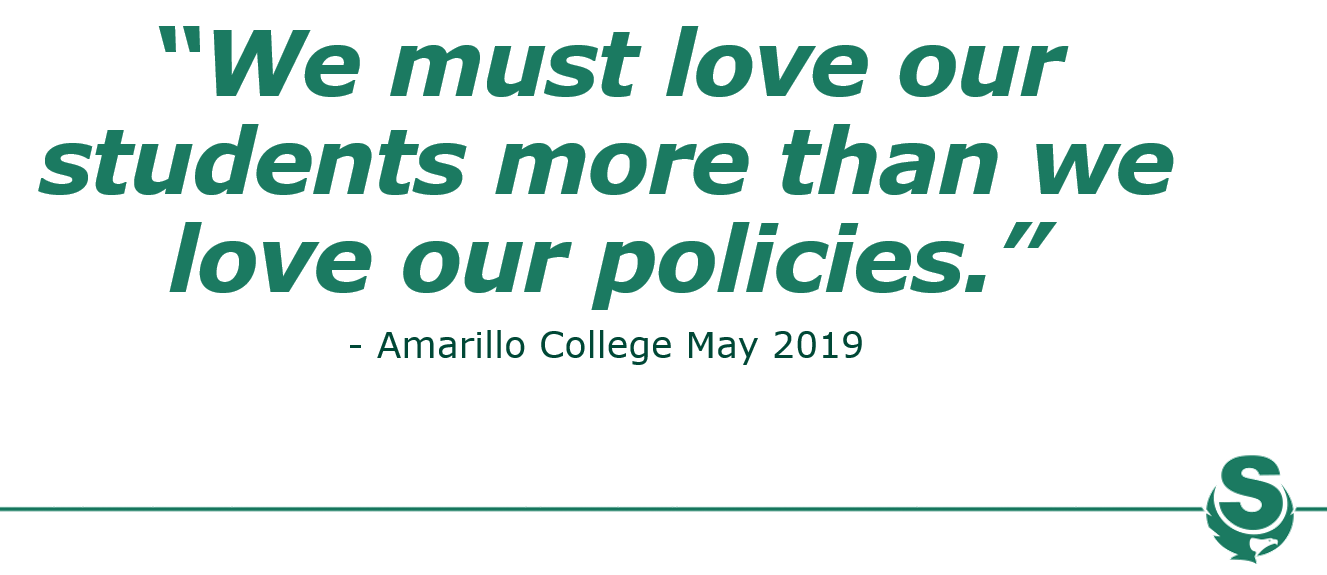
So, first let me say I get the uneasiness when we start looking at policy. My current job is Vice President of Academic Affairs, which means I have responsibility for a large number of policies. In fact, one of my year-one tasks is to review all academic policy for my college with my team. Colleges are large, complex organizations, and policy and procedures are needed to keep us open and able to do the work we do. I think some folks get nervous when I talk about students vs. policy because they think I mean anarchy:), but I'm really talking about embracing the gray areas and the difficulties of the work we do. In fact, my colleague Josiah Litant and I had the opportunity to spend a day at the Minnesota State System office early in my tenure visiting with our Vice Chancellor. Our wide-ranging discussion touched on a number of topics as I oriented to the system, but we were particularly focused on the statewide initiative called Equity 2030. In the course of that discussion, we talked about eliminating achievement gaps and barriers to doing so. I honestly can't remember who said it, but eventually someone said policy was, by design, inequitable because it tried to make blanket rules that treated everyone the same. We can quibble about the truth of the statement, but it seemed profound to me. If being poverty-informed is an equity-minded approach, we need to consider our policies and our use of them very carefully. I think we find our next point of discomfort right there.
Policy can save us from personal pain. It's not fun to make a decision which impacts someone else negatively. I will be spending this week analyzing appeals from students who have struggled academically who want to return to school. Our policies on this are pretty clear, and if I wanted to, I could use them as the reason I am choosing to take away someone's opportunity to go to school. That's what I mean when I say policy can save us from pain. The simplest thing would be to figure out if students were in compliance with stated policy and then decide if the student "deserved" to be reinstated. Well, anyone who has read my writing knows I hate the idea of "deserves", so I'm going to agonize over those decisions. I don't know if I will get them right, but I think we are obligated to live in that discomfort and look for the spaces in-between our policies if those spaces support students, particularly students built for norms they might not match. In a business like education, we can't run things strictly off flowcharts and decision trees. If we could, we could just be automated. I would argue gray area decisions are what makes us professionals, those difficult decisions where we have to wrestle with outcomes mentally and emotionally. So, I think asking people to love students more than policies can make people uncomfortable because owning the consequences of our decisions is difficult. I agree it is hard, but I believe a poverty-informed college commits to being in that difficult space.

Reconciling loving students, equity, policy, and being poverty-informed isn't easy. I don't think it will ever be, but it is what is required if we want to add humanity to our organizations in the way I think we should. The folks at Amarillo College have a talent for finding a turn of phrase worth envying, and I do have some envy. "Love your students more than you love your policies" is just about a perfect summation. It acknowledges the need for norms to run a large complex organization, while challenging us to look at policy through an equity lens. I would say it pushes us to go even further. It not only gives us permission to make exceptions to policy, it challenges us to examine policies and see if they are helping us move where we want to go. Policy at a poverty-informed college might look very different than what we are used to, in fact I would expect it to, given our current results. Thinking about the work of building policies like these (and living with the exceptions) gives me excitement and anxiety at the same time. As I get comfortable being uncomfortable, I suspect those feelings mean I'm on the right track.
Sunday, December 29, 2019
#MSCSoutheastCares: The Movement
Friday, December 20th marked four months since I made the move to Minnesota State College Southeast. Back in my first couple of weeks, I wrote about my excitement at finding a deep culture of caring on campus (read here), and I promised to tell the honest and authentic story of our growth. There were many reasons I was drawn to this unique college in the southeastern corner of Minnesota, but the primary one was a palpable sense of mission from the first day I explored campus. The college culture reminded me of the students I think we are here to serve: determined, optimistic, resilient, and maybe just a little under-resourced:). Although I'd been successful engaging people in pursuing poverty-informed solutions before, I knew a vice president received different opportunities to spread that message. So, I made a leap of faith and hoped I'd found a group of people to try to change the world with. Today I'd like to share some stories of the movement taking hold on our campus and the amazing people making it happen.
 One of the pleasant surprises upon arriving at campus was finding the phrase "build a poverty-informed infrastructure" in our strategic plan. This had already led to the creation of student-led food pantries on both campuses as well as a committment to make public transportation free for students. So, I started with the first thing I could think of, my old friend "The Bowl." The big blue party bowl came with me from my last college, and I took it to our Learning Resource Center in Red Wing and asked the coordinator if I could put out some snacks for whoever wanted them. She immediately said yes, and we started with the granola bars pictured. Within days, others were diversifying to fruit, gluten free
 snacks, and a variety of other items. I'm only able to be in Red Wing a couple of days a week, but the bowl has not been empty since I put it out. Our Winona Campus ran with the idea as well. I didn't have a lovely bowl for them, but they use the very nice baskets pictured here. Again, I do some personal shopping every week, but what goes in the bowl/basket goes way beyond what I provide. Grab and go food is a powerful place to begin in creating a poverty-informed culture.
 Speaking of food, as I mentioned earlier, both our campuses have student-run pantries to battle food insecurity. It was wonderful to get to campus and see students (and staff) making time to care for each other, but it got even better. In speaking with our Winona Senate President the first week on campus, he told me our construction program was partnering with our machining program to upgrade their pantry. The solitary shelf pictured here was what they were using to start, but he wanted something that felt better and more respectful. I also love how he always refers to students "shopping" at the pantry and provides bags from a local grocery store to do so. The new and improved pantry is pictured right below the original one. They were still stocking it when I took the photo. It's pretty fantastic. The foundation of our poverty-informed triangle is meeting basic needs, and our efforts around food and transportation are a strong start to the movement I hope we are building.

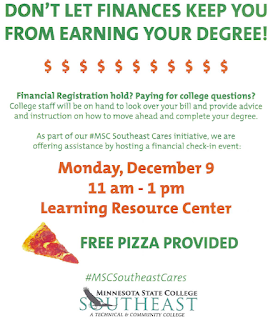 One of the strongest signs of our movement is the grassroots nature it is taking on. When you combine a shared mission with a deep culture of caring amazing things start to happen. If you season those things with a dash of autonomy, you get events like our financial check-in a couple of weeks ago. This originated with a simple problem solving mentality from our excellent student services staff. They knew we had a large number of students with a variety of financial holds preventing them for registering for spring term. They also knew that historically we hadn't done much other than send students an email to notify them of their status. So our staff decided to be more proactive. They created the poster pictured to the left. I love this poster so much! Look at how they phrased things, it's an invitation, not a warning. I think there is a huge difference between being "welcome" on campus and being "wanted" and this poster says the people we are serving are wanted. Several students came in for the face to face event, and several more reached out by email. Our staff were able to solve a remarkable number of issues and keep students in school. Think about the poverty-informed message this event sent. Rather than making our college a place you are in trouble with, the staff made it a place of help, of caring. That is powerful stuff.
So our movement has begun and #MSCSoutheastCares isn't just words, it is

actions. #MSCSoutheastCares is staff on both campuses creating a Saturday study time in the Learning Resource Center before finals. #MSCSoutheastCares is creating a new emergency fund for students and raising nearly $5000 in less than a month just from internal donations. #MSCSoutheastCares is having a better than 80% participation in our internal fundraising campaign for the MSC Southeast Foundation. But more than anything, #MSCSoutheastCares is a poverty-informed way of changing economic reality for students, families, communities, and the 7 Rivers region. It has been a remarkable first semester, and we are just getting started!


 Speaking of food, as I mentioned earlier, both our campuses have student-run pantries to battle food insecurity. It was wonderful to get to campus and see students (and staff) making time to care for each other, but it got even better. In speaking with our Winona Senate President the first week on campus, he told me our construction program was partnering with our machining program to upgrade their pantry. The solitary shelf pictured here was what they were using to start, but he wanted something that felt better and more respectful. I also love how he always refers to students "shopping" at the pantry and provides bags from a local grocery store to do so. The new and improved pantry is pictured right below the original one. They were still stocking it when I took the photo. It's pretty fantastic. The foundation of our poverty-informed triangle is meeting basic needs, and our efforts around food and transportation are a strong start to the movement I hope we are building.

So our movement has begun and #MSCSoutheastCares isn't just words, it is

actions. #MSCSoutheastCares is staff on both campuses creating a Saturday study time in the Learning Resource Center before finals. #MSCSoutheastCares is creating a new emergency fund for students and raising nearly $5000 in less than a month just from internal donations. #MSCSoutheastCares is having a better than 80% participation in our internal fundraising campaign for the MSC Southeast Foundation. But more than anything, #MSCSoutheastCares is a poverty-informed way of changing economic reality for students, families, communities, and the 7 Rivers region. It has been a remarkable first semester, and we are just getting started!
Tuesday, November 26, 2019
A Leader Informed by Poverty
I've been writing for some time about the necessity of realizing our students bring the entirety of their lives to our doorstep, and it matters. We do not serve people in isolation, we serve complex individuals with rich full lives. As the world has shifted to requiring post-secondary education for all, it has challenged those of us in post-secondary education to think differently about how we serve these students. I've written about this issue before (The Poverty Informed Triangle), but today I'd like to look at another issue. Specifically, I'd like to talk about what it means to lead when you are someone with lived experience in poverty. Just like our students come to us with a different context and world view, I think the same is true for our staff with lived experience. And just like our students who sometimes feel mismatched with our schools' polices and procedures, I think the same thing happens to those of us who work at the colleges. So, I'm going to deviate this week and talk about something from a completely personal perspective. Although I often use my experience as an example, this is different because I just want to tell you my experience. I don't know if others share it, but my gut says they do.
Let's start by being honest. The type of poverty I experienced growing up and later in my 20's would be considered mild by a lot of folks. We always had a roof over our heads, and generally food was in solid supply (with some help). So, this isn't a story about proclaiming my poverty, which ranged somewhere between blue collar poverty and situational. All I'm saying is a persistent sense of having less, and possibly being viewed as being less, has influenced my world view and how I do my work. In fact, it informs everything about me. So, it must mean it impacts me as a leader, and I'm guessing it does for people like me as well. Now I'm Vice President of a college, so my financial difficulty is behind me (I hope, but doubting is an outcome of my history too), but just like the students, it still lives inside me. And as I changed jobs this fall, I started to wonder what it means to lead from this mental and emotional place. I think it has an impact. I think it has strengths and challenges, but I think most of all it means others don't always see me or the situation the way I do. Let me share a couple examples.
Folks in poverty tend to be relationship based and live in a more oral culture. This means we can see connections and we think a lot about people when leading. Middle class people tend to talk more about achievement and goals. I know this is true because I've picked up lots of middle-class norms over the years. A traditional path to leadership often begins with the ability to "get stuff done", which seems very middle class. I've read extensively on leadership, and the literature often discusses the transition from being an outstanding individual performer (read 'get a lot of stuff done') to having to get work done through influencing others and how hard the change can be. What if your skill set ran the opposite way? I can only speak for myself, but it has always been easier for me to influence people's hearts and minds than it has been to accomplish processes and tasks. In fact, I joke about it all the time (for my whole career) because it can make me feel outside the norm and deficient. But I wonder, maybe it's just a reflection of my skill set, and maybe that skill set is less common, but just as important. Am I rationalizing? I don't know. I just know I can often feel like I'm missing skills I'm supposed to have, yet I'm having some success. I often think our students need a sense of belonging to overcome impostor syndrome. I wonder what we do for our leaders with similar backgrounds. If I'm honest, every career transition I've made has had aspects of sheer terror as I work through feelings that pretty soon someone will figure out I don't really know how this works. But after two decades of mostly successful work and advancement, that can't be true, can it? Could it be the skill set my life gave me is enough? It never feels that way, which leads to the next issue.
If you can be bilingual between poverty and middle-class, I come close. However, it leads to my most vulnerable places. If you are always sure at some level you are faking it until you make it, the odds of feeling inadequate and defensive are pretty high. Again, after twenty years in education, I cover pretty well, but I'm sensitive to things others aren't. I remember being at an after work dinner at a fairly upscale place on a business trip a few years ago. I was with a colleague and friend who came from a much more affluent background than I did, although we had the same job and title at that time. And when they served the meal, I reached for the pepper immediately, like always. My friend casually said, "aren't you going to taste the food before you season it?" It was a throwaway line between friends, and I doubt he could sense my reaction. But on the inside, I was in a spiral, and the hamster wheel in my mind was spinning furiously. My lack of class had been exposed. I was being judged. I was outed, and would never fit in. None of those things were true of course, but that's where my mind was. I don't remember the rest of the dinner, but I remember my shame and feeling very angry at my friend and his "pretentiousness." "I'm just as good as you, damn it. In fact, I'm better" was the refrain in my head. It seems kind of crazy as I type it, but it's been years, and I can pull the memory and the feelings up easily. It's one of many times I was pretty sure a small behavior meant I was being judged as inadequate and a fraud. If my experience is not just limited to me, I wonder how many other leaders go there too, and maybe are limited by their response.
So, we often read about the crisis of leadership, and I wonder if it is because we define it on a particular set of norms. Even while I feel like an impostor as I try to figure out structure and process and generate products, I am taking daily time to connect with the people I work with and learn their stories. But my own internalized insecurity tell me this isn't "work." It's wasting time and makes me a procrastinator, at least in my head. Of course, I'm pretty sure everyone else sees it too, but what if there is an alternative version to the story I tell myself. I'm getting to do a fair amount of public speaking in recent years (feel free to invite me to your place of work, it's my favorite thing), and people often approach me to chat when I am done. On rare occasions they want to challenge something I've said or learn more, but fortunately they are usually pretty complimentary. However, without fail, someone will approach me to say they also grew up in tough circumstances, and they have connected with what I have said. It's the best part of those days, but today it is making me wonder if we are missing out on some potentially excellent leaders. The people who approach me usually share with me privately and quietly as if we just joined a club we aren't supposed to tell anyone about. What if, just like I'm asking us to do with students, we approached people with the skill set poverty develops from a strengths-based perspective and made them feel welcome and not like impostors. If we acknowledged and celebrated the rich complexity of our leaders, perhaps we would get better outcomes for the richly complex people we serve.
Let's start by being honest. The type of poverty I experienced growing up and later in my 20's would be considered mild by a lot of folks. We always had a roof over our heads, and generally food was in solid supply (with some help). So, this isn't a story about proclaiming my poverty, which ranged somewhere between blue collar poverty and situational. All I'm saying is a persistent sense of having less, and possibly being viewed as being less, has influenced my world view and how I do my work. In fact, it informs everything about me. So, it must mean it impacts me as a leader, and I'm guessing it does for people like me as well. Now I'm Vice President of a college, so my financial difficulty is behind me (I hope, but doubting is an outcome of my history too), but just like the students, it still lives inside me. And as I changed jobs this fall, I started to wonder what it means to lead from this mental and emotional place. I think it has an impact. I think it has strengths and challenges, but I think most of all it means others don't always see me or the situation the way I do. Let me share a couple examples.
Folks in poverty tend to be relationship based and live in a more oral culture. This means we can see connections and we think a lot about people when leading. Middle class people tend to talk more about achievement and goals. I know this is true because I've picked up lots of middle-class norms over the years. A traditional path to leadership often begins with the ability to "get stuff done", which seems very middle class. I've read extensively on leadership, and the literature often discusses the transition from being an outstanding individual performer (read 'get a lot of stuff done') to having to get work done through influencing others and how hard the change can be. What if your skill set ran the opposite way? I can only speak for myself, but it has always been easier for me to influence people's hearts and minds than it has been to accomplish processes and tasks. In fact, I joke about it all the time (for my whole career) because it can make me feel outside the norm and deficient. But I wonder, maybe it's just a reflection of my skill set, and maybe that skill set is less common, but just as important. Am I rationalizing? I don't know. I just know I can often feel like I'm missing skills I'm supposed to have, yet I'm having some success. I often think our students need a sense of belonging to overcome impostor syndrome. I wonder what we do for our leaders with similar backgrounds. If I'm honest, every career transition I've made has had aspects of sheer terror as I work through feelings that pretty soon someone will figure out I don't really know how this works. But after two decades of mostly successful work and advancement, that can't be true, can it? Could it be the skill set my life gave me is enough? It never feels that way, which leads to the next issue.
If you can be bilingual between poverty and middle-class, I come close. However, it leads to my most vulnerable places. If you are always sure at some level you are faking it until you make it, the odds of feeling inadequate and defensive are pretty high. Again, after twenty years in education, I cover pretty well, but I'm sensitive to things others aren't. I remember being at an after work dinner at a fairly upscale place on a business trip a few years ago. I was with a colleague and friend who came from a much more affluent background than I did, although we had the same job and title at that time. And when they served the meal, I reached for the pepper immediately, like always. My friend casually said, "aren't you going to taste the food before you season it?" It was a throwaway line between friends, and I doubt he could sense my reaction. But on the inside, I was in a spiral, and the hamster wheel in my mind was spinning furiously. My lack of class had been exposed. I was being judged. I was outed, and would never fit in. None of those things were true of course, but that's where my mind was. I don't remember the rest of the dinner, but I remember my shame and feeling very angry at my friend and his "pretentiousness." "I'm just as good as you, damn it. In fact, I'm better" was the refrain in my head. It seems kind of crazy as I type it, but it's been years, and I can pull the memory and the feelings up easily. It's one of many times I was pretty sure a small behavior meant I was being judged as inadequate and a fraud. If my experience is not just limited to me, I wonder how many other leaders go there too, and maybe are limited by their response.
So, we often read about the crisis of leadership, and I wonder if it is because we define it on a particular set of norms. Even while I feel like an impostor as I try to figure out structure and process and generate products, I am taking daily time to connect with the people I work with and learn their stories. But my own internalized insecurity tell me this isn't "work." It's wasting time and makes me a procrastinator, at least in my head. Of course, I'm pretty sure everyone else sees it too, but what if there is an alternative version to the story I tell myself. I'm getting to do a fair amount of public speaking in recent years (feel free to invite me to your place of work, it's my favorite thing), and people often approach me to chat when I am done. On rare occasions they want to challenge something I've said or learn more, but fortunately they are usually pretty complimentary. However, without fail, someone will approach me to say they also grew up in tough circumstances, and they have connected with what I have said. It's the best part of those days, but today it is making me wonder if we are missing out on some potentially excellent leaders. The people who approach me usually share with me privately and quietly as if we just joined a club we aren't supposed to tell anyone about. What if, just like I'm asking us to do with students, we approached people with the skill set poverty develops from a strengths-based perspective and made them feel welcome and not like impostors. If we acknowledged and celebrated the rich complexity of our leaders, perhaps we would get better outcomes for the richly complex people we serve.
Sunday, November 10, 2019
A Tale of Two Students

Earlier this week, Cameron's teachers reached out with some concern for his performance and behavior. The teacher who wrote was obviously upset, and to be honest the note wasn't very kind. I was told he could "choose" to "earn" poor grades, but distracting behavior would not be tolerated. It was upsetting, but I'm an educator too, so I took a deep breath and sent an email. The email asked for further examples of their concerns. It also pushed back on some of the comments I thought were unfair and ended with an offer to talk by phone or in person. I got an immediate response and followed up with a relatively pleasant phone call. I was empathetic, but made it clear my son valued the class, and I was more worried about his learning than his GPA. When the teacher expressed concern because Cameron is a "college-bound" student, I shared I worked at a college and he could certainly go there, which I hope he will. It all ended well, and he remains in the class and is committed (he says) to trying to do more of what they want. If I'm honest, it's the type of conversation I've had annually with at least one teacher since my son started school. I don't make apologies for advocating for my son, but I've always had guilt around it because I am so keenly aware of people who don't have advocates like me. I know having college educated parents who feel like they are able to talk with school staff gets him the benefit of the doubt, and no one thinks it's unusual. It's just part of the built-in help middle class kids get, and no one thinks twice about it. The longer I work at this notion of being poverty informed, the more insidious it all seems. I'm afraid our systems (like schools) were built on unfair and inequitable principles to begin with, so they are designed to perpetuate those inequities. And that is only mitigated, if you have someone who can "work" the system, like I and other middle-class parents do for our children.

All of this made me think of another student I spoke with in the last two weeks. I don't have her permission, so I won't use her name. She is an adult who has none of the advantages Cameron has, and I think that makes her behavior suspect in situations no one would blink at for my son. She reached out to me after being removed from one of her courses due to a confrontation with an instructor. This student comes from generational poverty and her vocabulary and behavior do not indicate her intellectual ability (meaning she doesn't do middle class things). She also has a strongly developed sense of what she thinks is fair and what she thinks isn't fair. On this particular day, she believed her instructor was being unfair and would not back down on the topic. The instructor was pulled into an emotional reaction, and unfortunately the exchange ended with the instructor telling the student to "get the F#$% out of my class." I'm pretty connected to this student and started getting messages that night about what had happened. She had decided to drop out of school and had been ordered to stay off campus until the following Monday. And if she didn't tell me, the story ends there. I'm not the hero of the story, but I am someone with perceived power who could make phone calls and emails on her behalf to see what could be done. She could feel assured people would respond to my inquiries and the issue would be resolved. Sadly, she didn't believe her own self-advocacy would yield the same results, and she has a lifetime of evidence to support that belief. I spent 20 minutes on the phone and writing emails to key folks, and in the end, she returned to campus to try to finish the term. My title and status simply helped her navigate a situation like it would have for Cameron.
My heroes at Amarillo College tell us we have to love our students more than we love our policies. I think this is exactly what they are talking about. When people who know middle class norms violate policy, they (or their advocates) know how to negotiate and mitigate the response to those policy issues. But all too often for our students from poverty, it is just a confirmation of their powerlessness and a reminder they weren't supposed to be here in the first place, and therefore the end of the road. So, being poverty-informed changes the behavior of those of us in power in distinct ways. If we embrace this, it would remove the guilt of intervening on behalf of students who have nothing. For those of us who are parents, it would simply be the equivalent of what we would do for our children. I like to say that poverty-informed practice is an intentional choice to love the students we have. We do things differently for people we love, including using any tools in our toolbox to navigate a system which does not serve them. We should be on a dual track of navigating the flawed system and fixing it simultaneously, but in the meantime, I think everyone is entitled to the same privileges the handsome guy at the top of the article gets through an accident of birth.
Monday, October 28, 2019
Start with Strengths
As I've been writing, podcasting, and speaking over the last two years or so, I've made a number of connections across the country. Sometimes they are people I admire, or places that might be good collaborators, or just kindred souls. It's always nice to find like-minded folks, and it doesn't bother me to talk with people who want to challenge my ideas either. But the most meaningful interactions I get the privilege of having are conversations away from the podium. The nature of this work means I share things that are personal, which always feels weird, but inevitably someone will come up to me afterward, and they will share a similar experience. It's almost as if watching me embracing some of my own struggles (which pale compared to many) gives permission to embrace their own struggles and start to see them differently. So many of us have been deeply programmed to believe our struggles are due to our deficits, when in reality they are structural and overcoming them has created a set of strengths others may not even know about. Starting with strengths is a fundamental premise of poverty informed practice, but it's not as easy as it sounds. Let me try to explain.
Because I have chosen to share about my little movement on social media, people reach out to me on those platforms as well. I'd like to share one of the messages I received (with identifying information redacted of course), so you can see a problem you might not have anticipated. The note I received said this: "Chad, Have you heard about or worked on programs that simply prove existing skillsets? As a poverty survivor (former homeless) I find myself looking for certifications and classes that cover skills I have because I can't admit to their origin in a professional setting... Poverty survivors have to keep their street skills secret until an acceptable experience proves those skills exist- like certification. I know I'm not the only one but I never see or hear anything about finding a way to recognize the beneficial skills born out of horrible experiences." I did not have a very satisfying answer for the person who sent me the message, but it has stuck with me since the day I received it. Dr. Donna Beegle talks often about living in a country where we the poor for being poor, and here was a real life example in my inbox. This individual felt s/he had to hide the source of his/her strengths, and find "training" to cover for how s/he had really acquired these tools. That can't be ok.
Think about the opportunities this provides as poverty-informed practitioners. I see two in particular. The first opportunity is for those of us in perceived positions of power to share some of our struggles, especially if and when we received some key help. I think we need to normalize and de-stigmatize help every chance we get. So, for example, I have begun to be much more honest about the situational poverty of my 20's, which I had always blamed myself for. For many years, I would hide from my crooked path through college, and my loan defaults, and other errors which always felt like personal failures. Now, maybe some of this stuff was on me personally, but my shame around it, and the consequences of hiding it were very responsible for not getting the help I needed to get moving. And every time I disclose pieces of it, someone identifies, and I wish I hadn't waited almost 20 years to be brave about sharing it. If I'm honest, my current relative stability makes it easier to talk about it, which also indicates the depth of the shame around these issues.
The second opportunity is the chance to help the people we serve re-frame their struggles as learning and strengths. This is as simple and as complicated as changing intake procedures. In education, we so often start with an analysis of your weaknesses, often with academic testing. Testing is perhaps not a positive historical experience for our students, and then even more unfortunately, we tend to discuss it in a deficit model. This is the issue in well intended developmental education across the country. I know this because I led well intended work like that for many years. But now I see very clearly we were inadvertently telling students we would "fix" them before they started something meaningful. Instead, I would suggest intake start with a simple request "tell me what you have done." This seemingly small change can change everything in my opinion, particularly if we know how to respond. What if when we made this inquiry we listened, took notes, and just seemed interested? What if, even better, we took the opportunity to search for transferable skills in their prior accomplishments? What if, from the minute of arrival, we started talking about possibilities, and showed respect and awe for the skills it takes to survive in the crisis of poverty? Could the discussion change, and could the follow up tests etc. be framed differently then? A poverty informed program must think carefully about who the first point of contact is, and ideally that person(s) would be adept and nimble at translating life skills to college goals. Imagine a student coming in with the accumulated shame and doubt the crisis of poverty creates, and the first conversation they have celebrates the amazing tools they have developed to get to our door.
So often, I feel inadequate in this conversation because figuring out what to actually do is a struggle for me. But I'm committed to the idea, and I'm committed to doing the work through my own strengths. I heard the indefatigable Dr. Sara Goldrick-Rab say at #RealCollege2019 that step one in building the movement is to change the discourse. I think that is where my efforts are focused. One of the strengths I acquired along my journey is the ability to listen, communicate, and change people's minds. I'm so impressed and intimidated by folks who make structural change, and sometimes my own efforts feel too small and too easy. But in the same way I'm asking us to approach our students from a strengths-based perspective, I'm trying to give myself the same grace. While I am committed to a bias for action and for not stopping at navel gazing, I am trying to embrace my own strengths to change the discourse in my sphere of influence. For those of you who might struggle with the same insecurities I do (warning self-disclosure:)), I want to tell you a story. Last June, I was in an important meeting, with important people, and making the case for being both poverty and trauma informed. At the end of the meeting, the most important person in the room turned to me and said "I need to learn more because I don't really understand this 'poverty-informed' thing you are talking about." My heart sank and all my insecurities came back to the surface. I left that meeting, but rather than retreat, I leaned into my strength to change the discourse. And 18 months later, the college I left has the words "poverty-informed" in their strategic plan, my new college has a goal of "poverty-informed" infrastructure, and the hashtag #povertyinformed appears in my social media feeds daily. It took the relative safety of my middle-aged, middle-class privilege to make that happen. Let's not make others wait. What if we celebrated the strengths of the people we serve from the moment they arrive? What could we unleash with the simple change to starting with strengths?
Because I have chosen to share about my little movement on social media, people reach out to me on those platforms as well. I'd like to share one of the messages I received (with identifying information redacted of course), so you can see a problem you might not have anticipated. The note I received said this: "Chad, Have you heard about or worked on programs that simply prove existing skillsets? As a poverty survivor (former homeless) I find myself looking for certifications and classes that cover skills I have because I can't admit to their origin in a professional setting... Poverty survivors have to keep their street skills secret until an acceptable experience proves those skills exist- like certification. I know I'm not the only one but I never see or hear anything about finding a way to recognize the beneficial skills born out of horrible experiences." I did not have a very satisfying answer for the person who sent me the message, but it has stuck with me since the day I received it. Dr. Donna Beegle talks often about living in a country where we the poor for being poor, and here was a real life example in my inbox. This individual felt s/he had to hide the source of his/her strengths, and find "training" to cover for how s/he had really acquired these tools. That can't be ok.
Think about the opportunities this provides as poverty-informed practitioners. I see two in particular. The first opportunity is for those of us in perceived positions of power to share some of our struggles, especially if and when we received some key help. I think we need to normalize and de-stigmatize help every chance we get. So, for example, I have begun to be much more honest about the situational poverty of my 20's, which I had always blamed myself for. For many years, I would hide from my crooked path through college, and my loan defaults, and other errors which always felt like personal failures. Now, maybe some of this stuff was on me personally, but my shame around it, and the consequences of hiding it were very responsible for not getting the help I needed to get moving. And every time I disclose pieces of it, someone identifies, and I wish I hadn't waited almost 20 years to be brave about sharing it. If I'm honest, my current relative stability makes it easier to talk about it, which also indicates the depth of the shame around these issues.
The second opportunity is the chance to help the people we serve re-frame their struggles as learning and strengths. This is as simple and as complicated as changing intake procedures. In education, we so often start with an analysis of your weaknesses, often with academic testing. Testing is perhaps not a positive historical experience for our students, and then even more unfortunately, we tend to discuss it in a deficit model. This is the issue in well intended developmental education across the country. I know this because I led well intended work like that for many years. But now I see very clearly we were inadvertently telling students we would "fix" them before they started something meaningful. Instead, I would suggest intake start with a simple request "tell me what you have done." This seemingly small change can change everything in my opinion, particularly if we know how to respond. What if when we made this inquiry we listened, took notes, and just seemed interested? What if, even better, we took the opportunity to search for transferable skills in their prior accomplishments? What if, from the minute of arrival, we started talking about possibilities, and showed respect and awe for the skills it takes to survive in the crisis of poverty? Could the discussion change, and could the follow up tests etc. be framed differently then? A poverty informed program must think carefully about who the first point of contact is, and ideally that person(s) would be adept and nimble at translating life skills to college goals. Imagine a student coming in with the accumulated shame and doubt the crisis of poverty creates, and the first conversation they have celebrates the amazing tools they have developed to get to our door.
So often, I feel inadequate in this conversation because figuring out what to actually do is a struggle for me. But I'm committed to the idea, and I'm committed to doing the work through my own strengths. I heard the indefatigable Dr. Sara Goldrick-Rab say at #RealCollege2019 that step one in building the movement is to change the discourse. I think that is where my efforts are focused. One of the strengths I acquired along my journey is the ability to listen, communicate, and change people's minds. I'm so impressed and intimidated by folks who make structural change, and sometimes my own efforts feel too small and too easy. But in the same way I'm asking us to approach our students from a strengths-based perspective, I'm trying to give myself the same grace. While I am committed to a bias for action and for not stopping at navel gazing, I am trying to embrace my own strengths to change the discourse in my sphere of influence. For those of you who might struggle with the same insecurities I do (warning self-disclosure:)), I want to tell you a story. Last June, I was in an important meeting, with important people, and making the case for being both poverty and trauma informed. At the end of the meeting, the most important person in the room turned to me and said "I need to learn more because I don't really understand this 'poverty-informed' thing you are talking about." My heart sank and all my insecurities came back to the surface. I left that meeting, but rather than retreat, I leaned into my strength to change the discourse. And 18 months later, the college I left has the words "poverty-informed" in their strategic plan, my new college has a goal of "poverty-informed" infrastructure, and the hashtag #povertyinformed appears in my social media feeds daily. It took the relative safety of my middle-aged, middle-class privilege to make that happen. Let's not make others wait. What if we celebrated the strengths of the people we serve from the moment they arrive? What could we unleash with the simple change to starting with strengths?
Friday, October 18, 2019
A Sense of Belonging
One of the challenging things about leadership is it is not a "do it by yourself" thing. Most of us who end up in positions with some influence made our way there in part because at some point in our career we were good at accomplishing tasks and projects. However, when we are asked to lead others, accomplishing tasks on our own isn't the appropriate skill set in many ways. So you have to develop a new skill set, one that allows you to help other people understand what you are trying to do, and then embrace and execute it. It's a very difficult change, and I think it helps explain why so many of us struggle when we get into a leadership role. The tools in our tool box which worked so well no longer serve us. It can be very disconcerting, and on our worst days make us want to walk away from what we are doing and retreat to what we know. If this sounds personal, well sure it is. Every career transition I've made has involved some level of dealing with this incongruity, and I think it's complicated for people like me who felt like outsiders early on and always will. Now I'm not sharing this to have you feel sorry for me and my career (I'm just fine), but to hopefully draw the parallel to the students and individuals we serve. Students in the crisis of poverty have an extensive set of tools they use to cross our threshold, but those tools don't always work in our colleges. So what do we do?
As I've tried to boil down this idea of poverty informed practice to something other folks can embrace and execute, three elements keep repeating: meeting basic needs, creating a sense of belonging, and accelerating progress toward stability. I would never rank them because I think they all are interdependent, but today I'd like to talk about the importance of a sense of belonging. I would argue one of the consequences of pursuing college from the crisis of poverty is a feeling of not quite fitting in anywhere. On a personal level, this makes sense to me. It's been a long time since my family or I struggled financially (and our struggles were far less than many), but if I'm honest, the residue of feelings from those days persist until now. Every time I share these feelings with students or colleagues who are or have been in the crisis of poverty, they can identify. This happens almost without exception. Think about that. It means students come to us with a belief the people around them don't really want them there. Our students are pretty sure they are impostors, and all too often we inadvertently confirm those feelings. So how do we help them know they do belong?
 September 24th was our first Student Success day at Minnesota State College Southeast. I was a latecomer to the project as it had been initiated by my predecessor, and our Student Services team took the lead in planning it. My role was limited to support, encouragement, and participation. None of us were sure how it would go, but I'm pleased to say it was a hit at both campuses. Essentially we shut down classes for a day and faculty, staff, and external partners created workshop opportunities for students. Our student clubs and leadership groups also provided learning opportunities (on things like food insecurity!), and the afternoon was reserved for connecting with advising. The sessions offered were wildly eclectic, which reflected the grassroots nature of this day. There was financial aid and scholarship presentations, but we also had things like horses on campus to demonstrate equine massage. There were sessions on managing stress as a student and there were sessions on tuning pan drums (Did I mention we have really unique and cool music programs at MSC Southeast:)). There were lots of other sessions and activities and as a relative newcomer, I was able to see a thread that pulled it all together. My friend and mentor Dr. Donna Beegle talks frequently about identification theory as a tool for connecting with people in the crisis of poverty. My non-academic version is it's hard for people to hear you if they can't see something of themselves in you. Our eclectic sessions and informal atmosphere provided exactly that for our students, Students saw college staff in new ways. Students experienced sessions that connected with personal interests. And students saw college staff as people who wanted them there with us. The college was making every effort to be "us" rather than be "other." It was a pretty spectacular day, and I can't wait for the February version.
If you try to remember a mentor who made a difference in your life, they probably did lots of things. I've been lucky enough to have several good mentors, but they all had one characteristic in common. For me, they created a sense of safety, which was really another way of saying they made me feel like I belonged where I was. If you accept the poverty informed premise that we must love the students we have (not the ones we wish we had), how would you create the same experience for them? Would you be vulnerable enough to let them know a little bit about you in case they see themselves in your story? Would you fearlessly inventory your policies, practices, behaviors, facilities, and anything else you could identify to make sure there aren't messages of exclusion? This is the work it takes to begin to change our current outcomes and benefit our students, their families, and our communities.
I want to end by acknowledging how difficult this work can be. In recent years, I have given up a lot of the professional distance I used to maintain, and I'm encouraging you to do the same. I should be perfectly clear, we must all still be professional and ethical, but I think we have to be willing to let down our walls a little and let the student stories into our world. Being connected to the "why of the what" allows us to persevere when student journeys are non-linear, and on the days where our emotional investment leaves us in a place of vulnerability. Just this week, I had to deal with the fact a couple of students I had been pretty close to (in my prior life and in my new one) did things which were just not ok. Not only did that hurt me at a personal level, I'm always fearful it will lead to others thinking the work of including these students isn't worth it. That is the emotional risk of choosing to love the students you have and believing in them unconditionally. Sometimes it doesn't work out. I used to worry a lot more about these things, but in recent years, I've channeled my friend Cara Crowley and my answer is "So What." We don't stop doing the right thing because someone else didn't. We don't assign one person's behavior to an entire group (or we certainly shouldn't). This work can be lonely and uncomfortable on those days, and make no mistake there are people out there waiting for those moments of struggle to push you back to where you were. Can you imagine how the students feel in the same scenario? That's why creating a sense of safety and genuine belonging matters every day. That's why we do things alongside our students, and not just on their behalf.
As I've tried to boil down this idea of poverty informed practice to something other folks can embrace and execute, three elements keep repeating: meeting basic needs, creating a sense of belonging, and accelerating progress toward stability. I would never rank them because I think they all are interdependent, but today I'd like to talk about the importance of a sense of belonging. I would argue one of the consequences of pursuing college from the crisis of poverty is a feeling of not quite fitting in anywhere. On a personal level, this makes sense to me. It's been a long time since my family or I struggled financially (and our struggles were far less than many), but if I'm honest, the residue of feelings from those days persist until now. Every time I share these feelings with students or colleagues who are or have been in the crisis of poverty, they can identify. This happens almost without exception. Think about that. It means students come to us with a belief the people around them don't really want them there. Our students are pretty sure they are impostors, and all too often we inadvertently confirm those feelings. So how do we help them know they do belong?
September 24th was our first Student Success day at Minnesota State College Southeast. I was a latecomer to the project as it had been initiated by my predecessor, and our Student Services team took the lead in planning it. My role was limited to support, encouragement, and participation. None of us were sure how it would go, but I'm pleased to say it was a hit at both campuses. Essentially we shut down classes for a day and faculty, staff, and external partners created workshop opportunities for students. Our student clubs and leadership groups also provided learning opportunities (on things like food insecurity!), and the afternoon was reserved for connecting with advising. The sessions offered were wildly eclectic, which reflected the grassroots nature of this day. There was financial aid and scholarship presentations, but we also had things like horses on campus to demonstrate equine massage. There were sessions on managing stress as a student and there were sessions on tuning pan drums (Did I mention we have really unique and cool music programs at MSC Southeast:)). There were lots of other sessions and activities and as a relative newcomer, I was able to see a thread that pulled it all together. My friend and mentor Dr. Donna Beegle talks frequently about identification theory as a tool for connecting with people in the crisis of poverty. My non-academic version is it's hard for people to hear you if they can't see something of themselves in you. Our eclectic sessions and informal atmosphere provided exactly that for our students, Students saw college staff in new ways. Students experienced sessions that connected with personal interests. And students saw college staff as people who wanted them there with us. The college was making every effort to be "us" rather than be "other." It was a pretty spectacular day, and I can't wait for the February version.If you try to remember a mentor who made a difference in your life, they probably did lots of things. I've been lucky enough to have several good mentors, but they all had one characteristic in common. For me, they created a sense of safety, which was really another way of saying they made me feel like I belonged where I was. If you accept the poverty informed premise that we must love the students we have (not the ones we wish we had), how would you create the same experience for them? Would you be vulnerable enough to let them know a little bit about you in case they see themselves in your story? Would you fearlessly inventory your policies, practices, behaviors, facilities, and anything else you could identify to make sure there aren't messages of exclusion? This is the work it takes to begin to change our current outcomes and benefit our students, their families, and our communities.
I want to end by acknowledging how difficult this work can be. In recent years, I have given up a lot of the professional distance I used to maintain, and I'm encouraging you to do the same. I should be perfectly clear, we must all still be professional and ethical, but I think we have to be willing to let down our walls a little and let the student stories into our world. Being connected to the "why of the what" allows us to persevere when student journeys are non-linear, and on the days where our emotional investment leaves us in a place of vulnerability. Just this week, I had to deal with the fact a couple of students I had been pretty close to (in my prior life and in my new one) did things which were just not ok. Not only did that hurt me at a personal level, I'm always fearful it will lead to others thinking the work of including these students isn't worth it. That is the emotional risk of choosing to love the students you have and believing in them unconditionally. Sometimes it doesn't work out. I used to worry a lot more about these things, but in recent years, I've channeled my friend Cara Crowley and my answer is "So What." We don't stop doing the right thing because someone else didn't. We don't assign one person's behavior to an entire group (or we certainly shouldn't). This work can be lonely and uncomfortable on those days, and make no mistake there are people out there waiting for those moments of struggle to push you back to where you were. Can you imagine how the students feel in the same scenario? That's why creating a sense of safety and genuine belonging matters every day. That's why we do things alongside our students, and not just on their behalf.
Subscribe to:
Posts (Atom)